


BRAČA-SPORT paddles are available in fixed length or adjustable with 5cm or 10cm range depending on the model. The shaft on Braca paddles will be coded either K, (kayak fixed shaft) KAL (for kayak adjustable shaft) C (canoe fixed shaft) or CAL (canoe adjustable shaft) A guide to the common kayak/ski shaft codes and their suggested usage is outlined in the table below.
What paddle should I buy?
Kayak Paddle Infomation
Braca-sport Shaft Guide

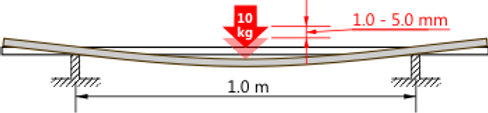
How Braca shaft stiffness is measured:
Blade Layup Options:
Braca wing blades come in four variants depending on the model;
1) Carbon 60 - a carbon/glass blend for a robust end product. A little heavier than a full carbon but also at a cheaper price point.
2) Carbon 100 - as the name would suggest, a 100% carbon layup.
3) Extra Light - carbon layup with a foam core to reduce resin consumption and therefore weight of the blades
4) Marathon - as per the carbon 100 layup but with added kevlar to the tips of the blades to help against chipping/cracking when paddling waters with submerged obstacles.
5) Surf - as per the extra light but with kevlar added to the shoulder of the blade for surf use.
Common Blade Volumes & Lengths:
600 - 690cm2 recommended for junior paddlers, usually less than 200cm long.
660 - 735cm2 recommended for sea kayak paddlers usually around the 210-220cm range
705 - 735cm2 most popular size for downwind ocean ski paddlers most common length is 208-218cm
735 - 770cm2 suggested for marathon race paddlers length usually determined by coaches with 5cm range
760 - 840cm2 suggested for sprint race paddlers length usually determined by coaches with 5cm range
Kayak/Ski paddles
1) Determine the length of your paddlers box as follows:
a) Grip a paddle (or broomstick), with elbows at right angles, shaft horizontal, resting on head, and measure from elbow to elbow outer edges behind the back (see photo on right).
b) Add 120cm to this length to get your sample paddle length.
For a junior paddler, add 110cm rather than 120cm.
2) Check suitability for your leg and torso ratio:
Measure your standing height to inside your curved fingers with your arm raised with your shoulders relaxed (photo 2 on right) Add this to your figure from step one and divide your answer by two. This new figure can be set as the mid-point for your paddle adjustment range.
eg 215cm would mean a paddle 210-220cm length or 212 -217cm for a 5cm range paddle.
3) Other considerations:
a) Does your paddle need to be used across craft of different beams eg Sea kayak, TK2 and ocean racing ski?
b) Does your usage involve a relaxed or aggessive paddle stroke? eg sea kayak touring vs downwind racing.
c) Do you have prior shoulder injuries that would benefit from a shorter paddle and reduced loading?


Determining a length for your paddle
There are a multitude of 'paddle length wizards' online offering advice on what length your paddle should be. If you are new to the sport or are a paddler without access to a coach sorting through the maze of information can be daunting. The information that follows is by no means an exact science, but will offer you a starting point to find your best fit. The length of paddle you require will vary according to a few factors; the width/freeboard of the craft you intend to paddle, whether you are paddling as a racer, for fitness, or touring and your physical body makeup (not just your height). If this is your first paddle, an adjustable shaft is reccomended as this will allow you adjustment in length as well as the ability to adjust your paddle feather angle until you find what is comfortable for you. Remember paddlers of the same height will have different length legs, torsos and arms, so will require differnent sized paddles. Paddlers with prior shoulder injusries will often opt for shorter length paddles with reduced volume to alter the loading on their shoulders and can compensate by running the paddle at a higher cadence. The guides below can be used as a starting point, with more fine tuning done on the water in your craft.
SUP Paddles
The starting point here is to simply add 15cm to your height in cm. We recommend for beginning/leisure paddlers to get an adjustable shaft with this calculation as the middle value in the paddle adjustment. This will allow you to adjust above and below this point by 2 cm to allow for different boards/conditions.
eg: A paddler of 180cm would require a 195cm paddle. If they purchase an adjustable paddle it would go from 193cm to 198cm.
Kneeling Canoe Paddles
For kneeling canoe (C1) the starting point for your paddle length should equal the distance from the ground to your eyebrow level when standing up straight.
Seated Canoe/Outrigger & Dragon Boat Paddles
The recommended starting point for these disciplines is for the paddle to reach your armpit when standing up straight with your shoulders relaxed. This method however does not take into account the ratio between your wing span and torso length which is a vital consideration for paddling in a sitting position. Therefore, in a seated on a bench or level surface, raise your arm in a straight upwards positon by your ear. Have a friend measure the distance from the bench to the middle of your palm. This will give a more accurate paddle length. For dragon boaters in particular however, we do recemmend an adjustable shaft as this will allow you to cater for your position in the boat; bow and stern paddlers may be working over a higher gunwhale than those seated in the engine room. For Dragon Boat, the maximum length allowed for competition use is 51 inches. For adjustable shaft paddles this means the longest paddle we can make for you is a 49-51cm paddle. For Outrigger and Canoe disciplines, a fixed shaft is recommended to avoid the clamp interfering with the motion of your hand swap while underway. If you paddle in an OC6, add an inch to the measurement calculated above as the boat will sit higher in the water. If on the other hand you paddle an OC2 then subtract an inch from the measurement above as you will be seated lower in the craft to aid stability and are therefore closer to the water. Paddlers moving between a number of outrigger craft may be best served by an adjustable shaft paddle.
Paddle Maintainence
Some basic maintainence will keep your paddle in top condition and it will serve you well for a long time.
-
Adjustable paddles should be stored in two pieces, including removing handles from dragonboat/outrigger paddles.
-
When paddling in salt water conditions, paddles should be washed in fresh water after use.
-
Spiggots should be sprayed periodcially with a lubricant such as Lanox to maintain the free movement of the adjustment mechanism of your paddle.
Clamps:
-
Adjustable paddles intended for use in flatwater (freshwater) are supplied with the Braca metal clamp system, an aluminium collar with stainless axle, lock lever and screws. This system provides excellent grip and will last many years when maintained with periodic lubricant and washed properly in fresh water after use in brackish conditions.
-
Adjustable paddles for use in salt water conditions are supplied with the Braca nylon clamp system. This system gives better protection against galvinic corrosion for paddles exposed to salt water. These clamps will wear quicker than a metal clamp and are to be considered a semi-disposable component. The cost of the nylon system allows for a 2:1 replacement ratio against the metal clmap version and can be a DIY swap over for many paddlers (alretnatively we can take care of this for you).